Model Context Protocol (MCP): The New Standard for Connecting AI to Your Tools
What MCP actually standardizes, why it matters for AI architecture, and how it changes the way LLMs connect to your APIs, databases, and internal tools.
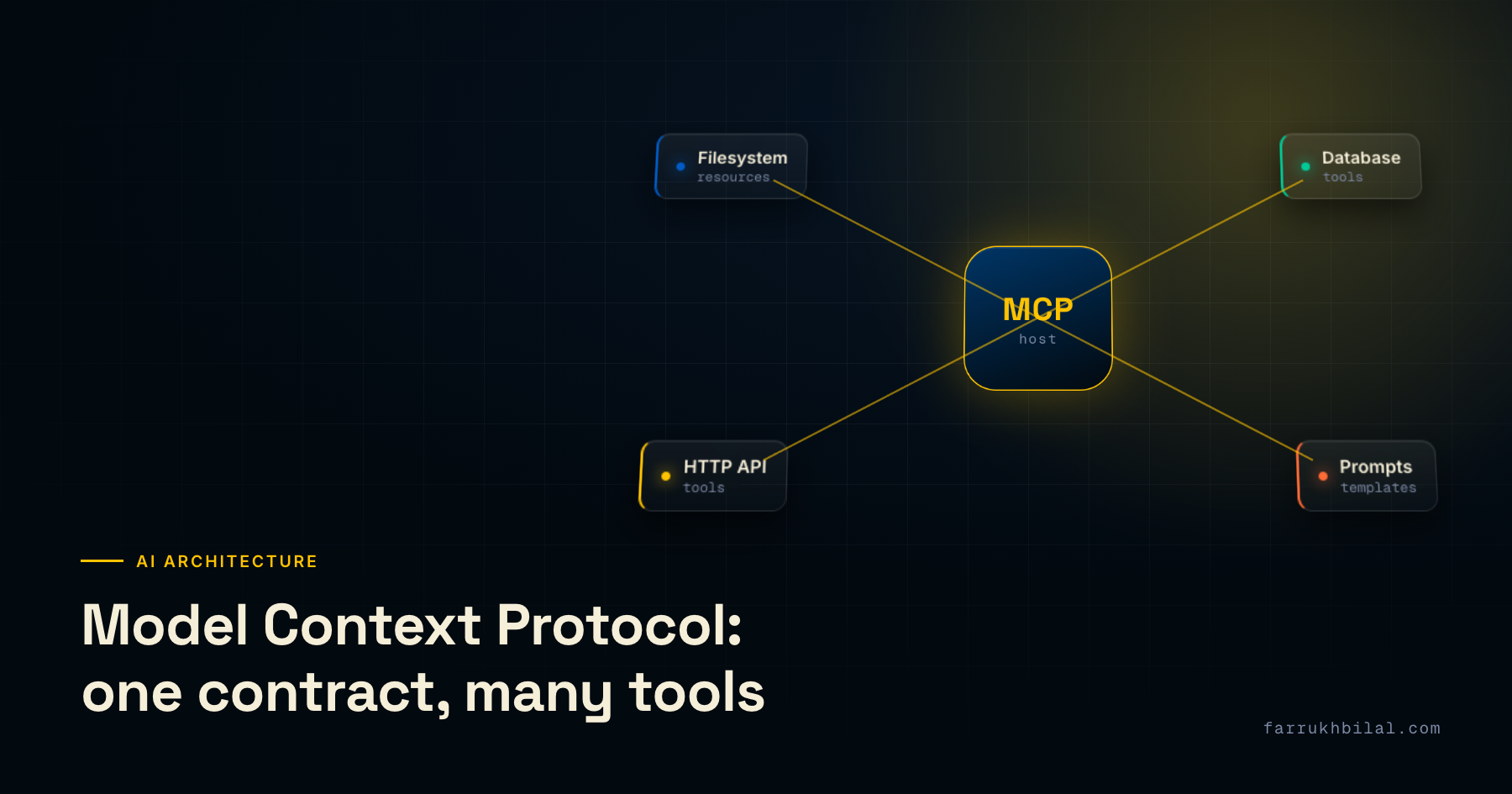
Before MCP, every AI application that wanted to connect a model to an external tool — a database, a file system, a SaaS API — wrote its own bespoke integration. Multiply M applications by N tools and you get M×N one-off integrations, each with its own auth handling, its own schema conventions, its own bugs. MCP exists to collapse that to M+N.
The problem it solves
Function calling (tool use) already lets a model call a tool mid-conversation. MCP doesn't replace that — it standardizes how tools are described and served so the same tool integration can be reused across any MCP-compatible client, instead of being rewritten per application.
Think of it as roughly analogous to what a REST API convention did for web services, or what LSP (Language Server Protocol) did for editor-language integrations: it's a common interface, not a fundamentally new capability.
The core pieces
MCP servers expose capabilities — tools (actions the model can invoke), resources (data the model can read), and prompts (reusable prompt templates) — over a standard protocol. A server might wrap a database, a filesystem, a ticketing system, or an internal API.
MCP clients live inside the AI application (an IDE, an agent framework, a chat interface) and connect to one or more servers, presenting their tools and resources to the model in a consistent shape regardless of which server they came from.
The host application — your product — orchestrates which servers are available in a given session and mediates the model's use of them.
What this actually buys you architecturally
If you're building an AI product that needs to touch several internal systems, MCP means you write one server per system once, and it's reusable across every AI feature you build afterward — the customer-support agent, the internal ops assistant, the IDE plugin — instead of re-wiring the same database access three separate times with three separate ad-hoc schemas.
It also means you can adopt tools built by others. An MCP server for a common SaaS product, written once by anyone, works with your AI application without custom integration work on your end.
Building an MCP server, conceptually
At a minimum, a server declares its available tools with a name, a description, and a JSON schema for its inputs — the same shape a model already expects from function-calling definitions, which is part of why MCP composes cleanly with existing tool-use patterns rather than fighting them. The server implementation then just needs to execute the tool call against the real system and return a result in the expected shape.
The design work that actually matters is the same as any API design work: clear tool boundaries, predictable error responses, and descriptions written for a model to reason about — not just human-readable documentation as an afterthought.
Security is not optional
An MCP server is a privileged bridge between a model and a real system. Scope its credentials tightly — a read-only database tool should hold a read-only connection, not the same credentials your admin panel uses. Treat every tool call as if the model's reasoning could be manipulated by adversarial input in whatever it's currently processing, because it can be.
Where it fits
MCP isn't a replacement for a well-designed backend API — it's a standard way to expose one to an AI client. If you're building AI features that need to reach beyond a single conversation into real systems — databases, internal tools, other services — designing that boundary as an MCP server rather than a one-off integration is, in my experience, the difference between a feature that scales across products and one you rebuild every time.
Related articles
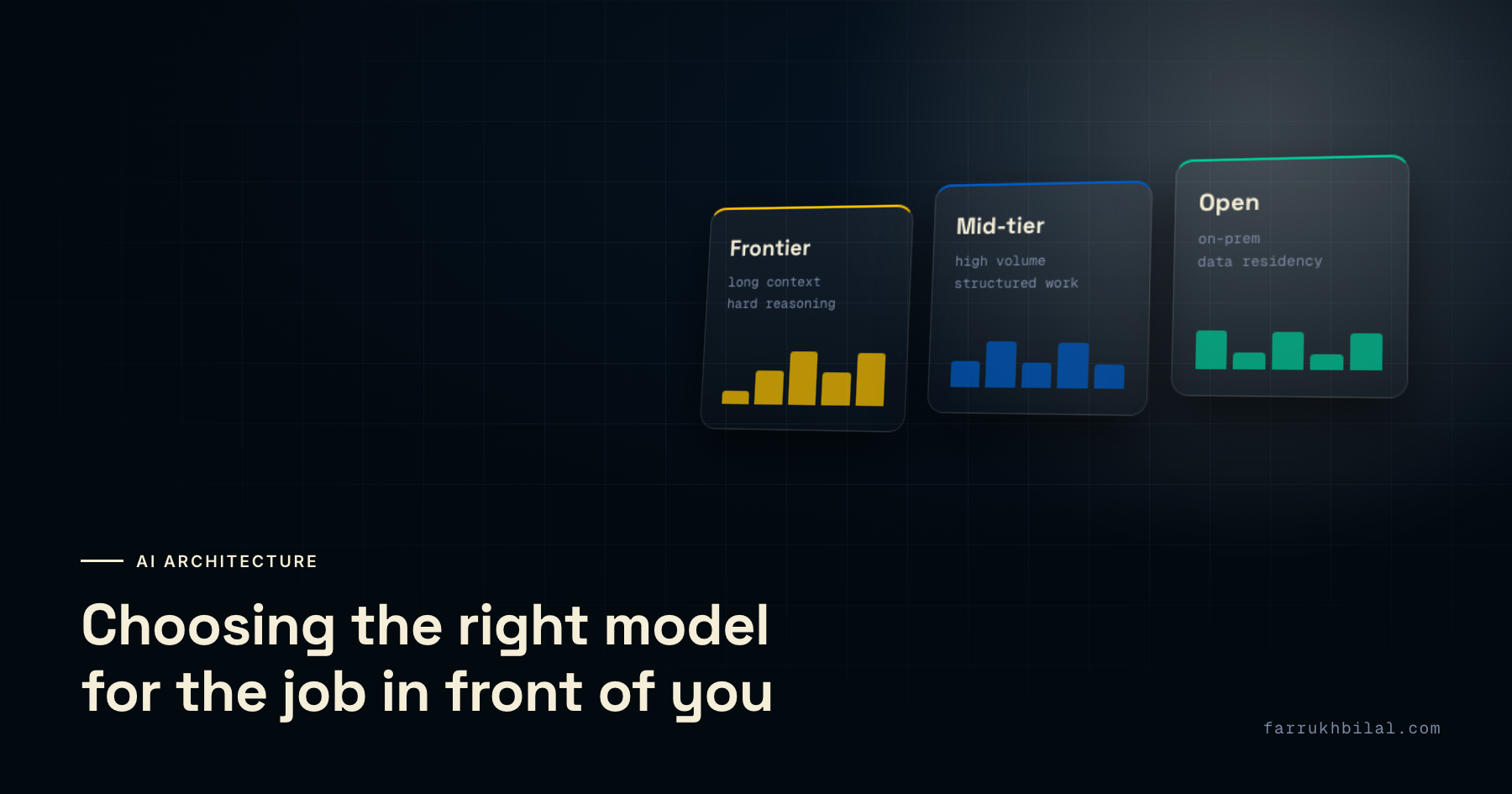
Claude vs GPT vs Open Models: Choosing the Right LLM for Your Architecture
There's no single best model — there's a best model for your constraints. A practical framework for picking an LLM based on task, latency, cost, and data sensitivity.
Aug 14, 2026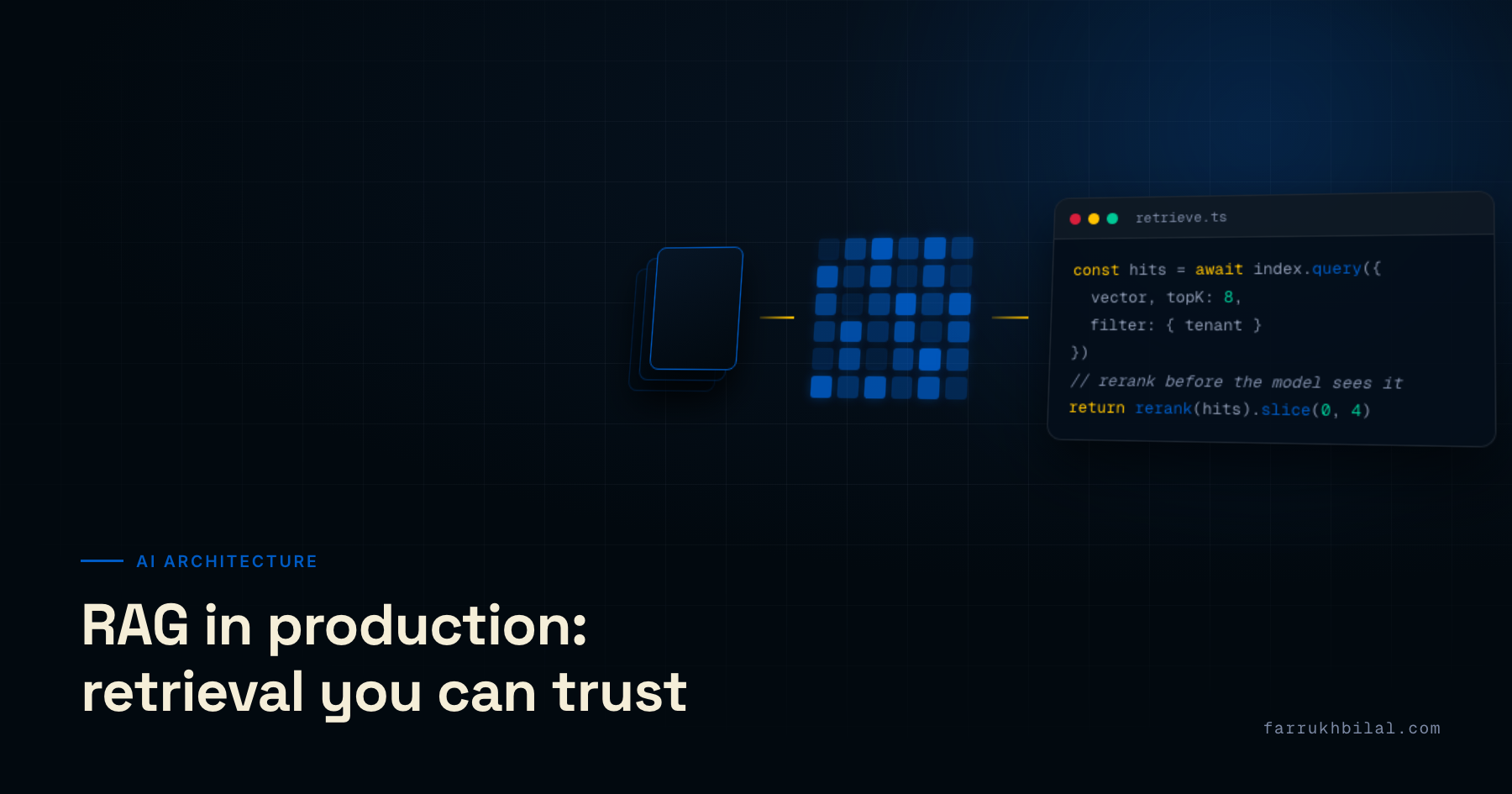
RAG in Production: Lessons from Building Document-Intelligence Pipelines
Retrieval-augmented generation looks simple in a tutorial. Here's what actually breaks when you put it in front of real documents and real users.
Jul 10, 2026