Token Optimization: Cutting LLM Costs Without Sacrificing Quality
Practical techniques for reducing token spend in production LLM systems — prompt design, caching, model routing, and knowing when a smaller model is enough.
Token cost is invisible until it isn't. A prototype that costs a few cents per request looks free — until it's handling real traffic and the monthly bill is the thing your client asks about first. Token optimization isn't about being cheap; it's about making the cost curve match the value curve as usage scales.
Why it matters more than it looks like it should
LLM pricing is per-token, both input and output, and the cost compounds in ways that aren't obvious from a single request. A system prompt re-sent on every call, a conversation history that grows unbounded, a retrieval step that stuffs ten chunks into context when three would do — none of these look expensive individually. At scale, they're the entire bill.
Prompt-level optimization
Start with the system prompt. If it's re-sent on every request — and it usually is — every unnecessary sentence in it is a recurring cost, not a one-time one. Write it like production code: precise, not verbose. Remove instructions the model doesn't actually need for the task at hand, and test that removing them doesn't degrade output quality before assuming they were dead weight.
Context window discipline
The instinct to "just include everything, the context window is huge now" is expensive and often counterproductive — more context isn't free, and irrelevant context measurably hurts output quality, not just cost (see the RAG piece above on retrieval precision). Include what's relevant, not everything that's available.
For multi-turn conversations, don't naively resend the full history forever. Summarize older turns once they stop being immediately relevant, and keep the summary, not the transcript.
Caching strategies
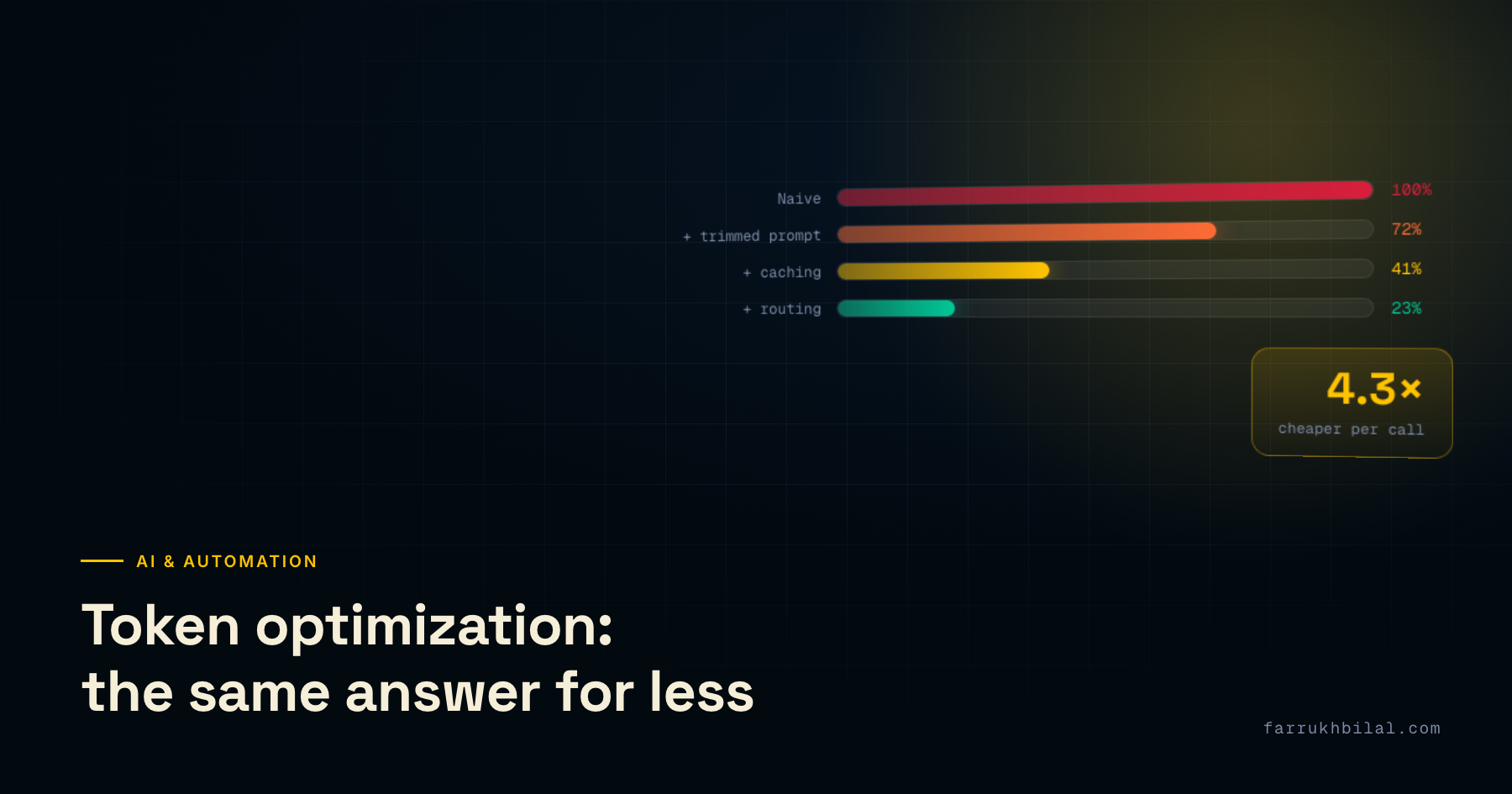
Several providers now support prompt caching — reusing the processing cost of a repeated prefix (like a long system prompt or a large document) across requests, at a fraction of the cost of reprocessing it each time. If your application repeatedly sends the same large context with a different final question, structuring the prompt so the stable part comes first and is cache-eligible is one of the highest-leverage optimizations available, often cutting the cost of that portion by most of an order of magnitude.
Model routing
Not every request needs your most capable, most expensive model. A classification task, a simple extraction, a yes/no decision — route those to a smaller, cheaper model, and reserve the frontier model for the requests that actually need its reasoning depth. A router step that classifies request complexity first, then dispatches accordingly, routinely cuts blended cost significantly without a user-visible quality drop on the easy cases.
Output length control
Output tokens typically cost more than input tokens. An open-ended prompt invites an open-ended (long) answer. Where the use case allows it, constrain the expected output — ask for a specific format, cap the length explicitly, or request structured output instead of prose you'll parse anyway.
Measuring the right thing
The metric that matters isn't cost-per-token — it's cost-per-successfully-completed-task. A cheaper model that fails and triggers a retry, or produces output a human has to fix, can easily cost more end-to-end than a pricier model that gets it right the first time. Optimize the whole pipeline's outcome, not a line item in isolation.
None of this is about extracting the last cent out of a request. It's about building AI systems where the cost structure scales sanely with usage — so the architecture that works in a demo still works, and still makes financial sense, once it's actually shipped.